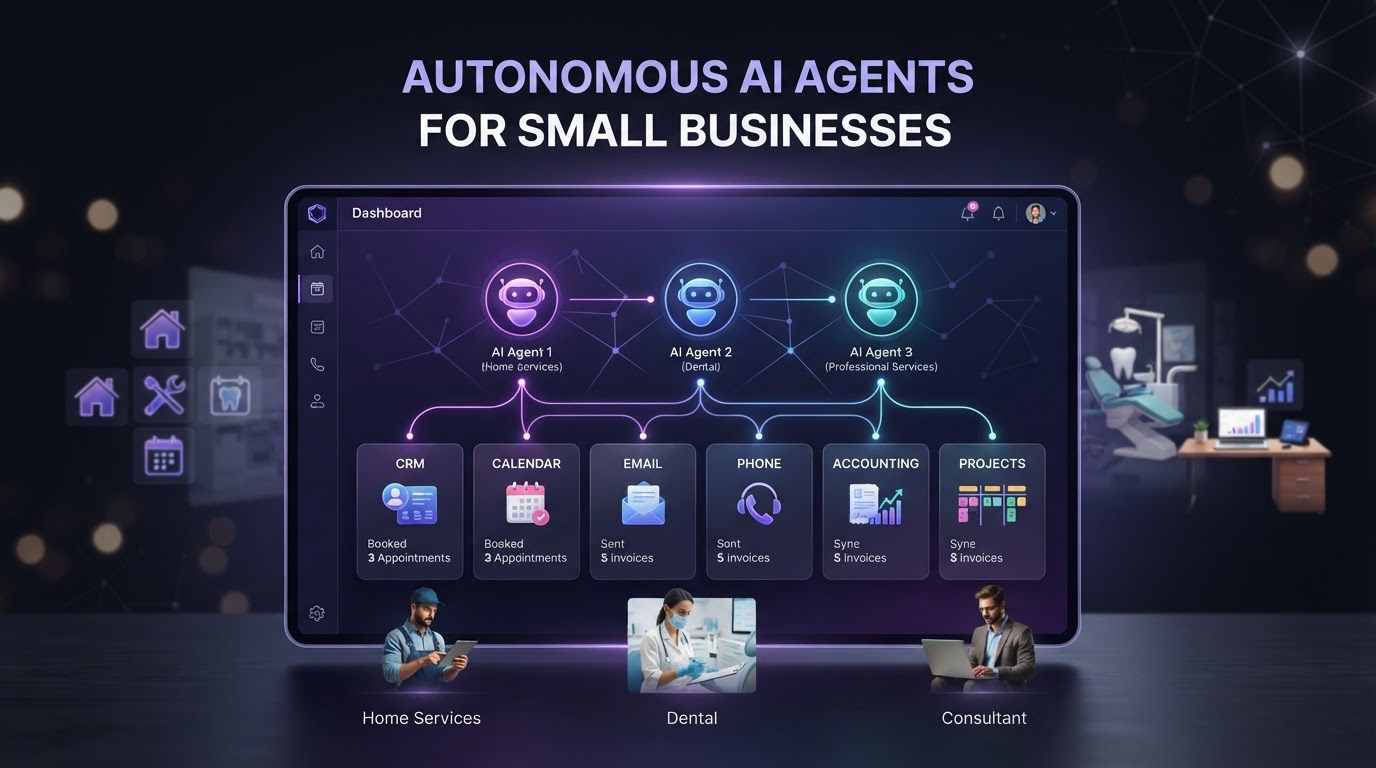
What is a Local AI Agent? Do You Need One or Just a Better Process?
Before you buy an AI agent, run this 3-part audit. You might find you don't need AI yet — you need a better form.

On this page
- Don't Automate a Broken Process
- Part 1: What to Document
- Part 2: What to Measure
- Part 3: Decision Tree
- What This Looks Like in Parrish
- Risks You Need to Manage
- The Pass/Fail Test
- FAQ
- What is a local AI agent?
- Does every small business need an AI agent?
- What is an AI audit?
- What risks come with AI agents?
- Download the 1-Page Audit Checklist
- Local E-Biz Solutions Team
Quick answer: A local AI agent is an AI assistant that answers questions, qualifies leads, and books appointments for a local business. But before buying one, you should audit your process — because if your workflow is broken, AI just automates the confusion. Run the 3-part checklist below first.
Don't Automate a Broken Process
An AI agent can answer questions, qualify leads, book appointments, and follow up automatically. That's useful — when the process behind it is clear.
If your sales process is unclear, your AI agent won't know how to guide people. If your intake is messy, it will collect messy data. If your team doesn't handle qualified leads well, faster capture just creates faster dropped balls.
So before you buy anything, run this 3-part audit. It takes an afternoon and will tell you whether you need AI or just a better form.
Part 1: What to Document
Write down — in plain language — the following:
- Offer: What exactly do you sell, and at what price range?
- Service area: Which cities and ZIP codes do you actually serve?
- Lead sources: Where do leads come from — website, calls, referrals, ads?
- Intake: What information do you need from a new lead to qualify them?
- Sales steps: What happens between first contact and a booked job?
- Policies: Cancellation, refund, warranty, emergency response rules?
- Tech stack: What CRM, calendar, phone system, and forms are you using today?
If you can't answer these in one sitting, your AI agent can't either. An AI agent needs approved, documented information to work from.
Part 2: What to Measure
Track these metrics for two weeks. The red flags tell you where to fix first.
| Metric | What to Track | Red Flag |
|---|---|---|
| Missed calls | Calls that go to voicemail or are unanswered | More than 10% of total calls |
| Speed to response | Time from form submit to first human reply | Over 1 hour during business hours |
| Lead leakage | Leads that never get a follow-up | Any lead with zero follow-up |
| Booking rate | Percentage of qualified leads that book an appointment | Under 30% |
| No-show rate | Booked appointments where the customer doesn't show | Over 20% |
| Repetitive questions | Questions you answer multiple times per week | Same 5 questions asked repeatedly |
If your red flags are in speed and follow-up, AI can help. If your red flags are in booking rate or no-shows, you likely need a better sales process or reminder system — not necessarily AI.
Part 3: Decision Tree
Use this to decide what you actually need:
- You need a better form or SOP if: Your process isn't documented, your team gives inconsistent answers, or leads arrive but nobody knows who follows up.
- You need a CRM or reminder system if: Leads fall through the cracks, no-shows are high, or you're tracking leads in a spreadsheet or inbox.
- You need an AI agent if: Your process is documented, your team is trained, but you're losing leads to slow response, after-hours gaps, or repetitive questions that eat staff time.
Good implementation looks like this: document the process, fix the obvious leaks, then add AI where it removes friction — not everywhere.
What This Looks Like in Parrish
Example 1 — A contractor in Parrish. A roofing company gets calls while crews are on roofs. Their AI agent asks: "What type of project — repair, inspection, or full replacement? What's your ZIP code? Is this an emergency or can it wait 48 hours?" That information goes straight into the CRM so the owner can prioritize callbacks.
Example 2 — A med spa in Lakewood Ranch. After-hours visitors fill out a form. The AI agent asks: "Which treatment are you interested in? Are you a new or returning client? What day works best?" It sends a booking link and flags HIPAA-sensitive questions for human follow-up — the bot does not give medical advice.
Risks You Need to Manage
- AI hallucination: AI can confidently give wrong answers. You need approved response scripts and a human review of edge cases.
- TCPA compliance: Automated text messages must follow TCPA rules — opt-in, opt-out, and quiet hours. Non-compliance can result in fines per message.
- HIPAA / medical spas: If you handle health information, your AI tools must be HIPAA-compliant. Do not let an AI agent collect or store protected health data without proper safeguards.
- Data privacy: Know where your AI provider stores data and whether it's used to train models. This matters for client trust and legal compliance.
- Liability: If your AI agent gives pricing, scheduling, or service advice that's wrong, you're responsible. Set boundaries on what the bot can and cannot commit to.
- Human handoff: Define exactly when the bot escalates to a person — complaints, complex questions, regulated topics, or anything it's not sure about.
- Transcript logging: Keep logs of AI conversations so you can audit what was said and catch problems early.
The Pass/Fail Test
Before you launch an AI agent, ask yourself:
"If I put an AI agent on my site tomorrow, what would it say when someone asks: 'How much does a new roof cost in Parrish?' or 'Do you take my insurance?'"
If you can't answer that question with a documented, approved response, your AI agent can't either. Fix the documentation first.
FAQ
What is a local AI agent?
An AI assistant that handles tasks for a local business — answering website questions, qualifying leads, booking appointments, and sending follow-ups. It works best when the underlying process is documented and clear.
Does every small business need an AI agent?
No. Some businesses need a better intake form, a documented SOP, or a CRM cleanup first. If your process is broken, automating it just creates faster confusion.
What is an AI audit?
It documents your current process, measures where leads and time leak out, and uses a decision tree to determine whether you need an AI agent or a simpler fix.
What risks come with AI agents?
AI can hallucinate wrong answers, violate TCPA texting rules, expose HIPAA-protected data, and create liability in regulated industries. You need human handoff rules, transcript logging, and compliance review before launch.
Download the 1-Page Audit Checklist
Get the full 3-part audit framework as a printable checklist. Run it on your business in one afternoon.

Local E-Biz Solutions Team
The leading experts in Generative Engine Optimization (GEO) and AI automation for local businesses in the North River area, including Parrish, Palmetto, and Ellenton. We help businesses stop revenue leakage and scale with modern technology.